


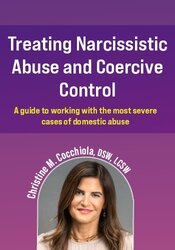
Treating Survivors of Domestic & Narcissistic Abuse: A Comprehensive Trauma-Based Treatment Model
- Speaker:
- Christine Cocchiola, DSW, LCSW
- Duration:
- 6 Hours 03 Minutes
- Language:
- Presented in EN, subtitles in EN, ES, DE, IT, and FR, handouts in EN, ES, DE, IT, and FR
- Copyright:
-
18 Sep, 2024
- Product Code:
- NOS096347
- Media Type:
- Digital Seminar

Description
Coercive control is at the core of all domestic abuse.
And when it occurs in the context of narcissism, this insidious behavior can become incredibly dangerous.
As a therapist, there are few issues that will challenge you in the way coercive control can --- because it requires you to overcome gaslighting, emotional manipulation, financial control, and sexual coercion that only gets worse when your client tries to escape it.
To effectively help your client, you need specialized knowledge and the right skills to navigate the treacherous path to safety – or you’re likely to do more harm than good.
Christine Cocchiola, DSW, LCSW, has dedicated her career to discovering the safest and most effective ways to help clients experiencing domestic and narcissistic abuse. Her trainings have equipped clinicians around the world to help their clients break free from coercive control.
And now, she is offering this truly unique training to share with you her step-by-step framework for recognizing and overcoming abusive coercive control tactics ...
... that will fully equip you with the skills and confidence you need to guide your clients to safety and help them transform from victim to survivor.
Credit
Speaker

Christine Cocchiola, DSW, LCSW Related seminars and products
Christine Marie Cocchiola, DSW, LCSW, a college professor teaching social work for the last 20 years, has been a social justice advocate since the age of 19, volunteering for a local domestic violence/sexual assault agency. Her doctoral work focused on the experiences of adult and child victims of coercive control as a form of domestic violence. She understands the impact that coercive control has on adult and child victims and her expertise as a trauma trained therapist, a researcher, and a protective mother is focused on supporting these vulnerable populations.
Speaker Disclosures:
Financial: Dr. Christine Cocchiola maintains a private practice and serves as CEO & President of Coercive Control Counseling, Inc. She has employment relationships with the NYU Silver School of Social Work, the University of Connecticut (UCONN) School of Social Work,, and Naugatuck Valley Community College. She is the founding member of the International Coercive Control Conference and the creator of the Child Sexual Abuse Prevention Workshops. Dr. Cocchiola receives royalties as a published author and receives a speaking honorarium and recording royalties from PESI, Inc. She has no relevant financial relationships with ineligible organizations.
Non-Financial Disclosures: Dr. Cocchiola is a Founding Member of the International Coercive Control Conference and serves as a Board Member of the National Coalition Against Domestic Violence. She also serves as a journal peer reviewer.
Additional Info
Program Information
Access for Self-Study (Non-Interactive)Access never expires for this product.
For a more detailed outline that includes times or durations of time, if needed, please contact cepepesi.com
Objectives
- Identify Coercive Control and the tactics used by Coercive Controllers [abusers] to harm adult and child victims.
- Examine the implications of Systemic Coercive Control and the harms inflicted on to victims and survivors.
- Recognize trauma responses to domestic violence, narcissistic abuse and coercive control in the clinical presentation of victims and survivors.
- Determine the differences between the personality traits of coercive controllers and their victims.
- Utilize a trauma-informed approach to overcoming self-doubt and the effects of gaslighting when working with victims and survivors.
- Summarize current best practices for supporting victims and survivors of domestic violence, narcissistic abuse and coercive control.
Outline
Module 1: Coercive Control: The Root of Domestic and Narcissistic Abuse
- Understanding the relationship between domestic abuse, narcissism and coercive control
- The common signs of coercive control ... plus signs you are likely to miss
- The impact of coercive control on the family system
- How coercive control infiltrates systems
Module 2: Dynamics of Coercive Control
- Common characteristics of a Coercive Controller
- Who is being controlled?
- The most common methods of abuse
- Distinguishing the abuser and the abused ... and why it can be so hard to tell the difference
Module 3: Treatment Part 1: Before you Begin
- What every therapist needs to know about working with coercive control
- The most common ways coercive control can impact your clinical judgement and what you can do to protect yourself against it
- When to consult and how to find the right consultation
- Managing countertransference
- The resources you need to know to support your clients
Module 4: Treatment Part 2: Navigating the Domestic Abuse Process
- Best practices begin with recognizing the abuse
- How to assess relationships for domestic and narcissistic abuse
- How to raise the topic with client: Guidance for individual and couples' therapists
- How to “ungaslight” your client
- Helping clients manage anxiety and self-doubt
- Safety planning and preparing for the risks of escape
- Helping your client to gain agency after years of gaslighting and diminishing behaviors
Module 5: Treatment Part 3: From Victim to Survivor: Trauma Treatment and Beyond
- Recommendation for trauma-focused treatment
- How to know when someone is begin processing the fallout of the abuse
- Risks of the work and how to best protect yourself
- Limitations to the research
Target Audience
- Counselors
- Social Workers
- Psychologists
- Psychotherapists
- Therapists
- Marriage & Family Therapists
- Addiction Counselors
- Case Managers
- Physicians
- Nurses
- Other Mental Health Professionals
Reviews
| 5 |
|
| 4 |
|
| 3 |
|
| 2 |
|
| 1 |
|
Overall: 4.7
Total Reviews: 147
Satisfaction Guarantee
Your satisfaction is our goal and our guarantee. Concerns should be addressed to info@pesi.eu.
Please wait ...