


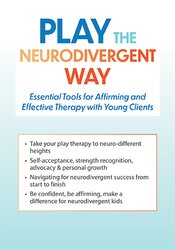
Play the Neurodivergent Way
Essential Tools for Affirming and Effective Therapy with Young Clients
- Speaker:
- Robert Jason Grant, EdD, LPC, NCC, RPT-S™
- Duration:
- 6 Hours 20 Minutes
- Language:
- Presented in EN, subtitles in EN, ES, DE, IT, and FR, handouts in EN, ES, DE, FR, and IT
- Copyright:
-
19 Apr, 2024
- Product Code:
- POS059670
- Media Type:
- Digital Seminar

Description
Neurodivergent children represent a unique and large part of young clients in play therapy—Autistic, ADHD, learning differences, sensory differences—yet their needs continue to be misunderstood and neglected.
You may unintentionally implement play therapy approaches that can be harmful whereby promoting masking, ableism, and internalized negative self-worth.
As a therapist, being confident that you’re affirming and effective in your play therapy work is essential!
It’s time to embrace and support the diversity of neurological differences!
Watch Dr. Robert Grant, expert in working with neurodivergent kids, as he shows you how to celebrate the unique ways in which individual brains function. You’ll learn how to create a safe play therapy environment through interventions, reflective exercises, and case examples for neurodivergent children to explore, heal, and grow!
Play the neurodivergent way, shows you step by step how to implement non ableist and neurodiversity affirming play therapy by:
- Understanding the intake process
- Setting up your office and play space to honor child’s play preference
- Understanding the child’s individual spectrum of presentation
- Establishing therapy goals
- Implementation of therapy approach and intervention
- Completing therapy - termination
Therapists will gain confidence in applying neurodiversity affirming play therapy to help neurodivergent young clients obtain self-acceptance, self-expression, strengths recognition, advocacy, and personal growth.
Don’t miss this one-of-a-kind chance to confidently support your neurodivergent kids!
Credit
Speaker

Robert Jason Grant, EdD, LPC, NCC, RPT-S™ Related seminars and products
Dr. Robert Jason Grant is the creator of AutPlay® Therapy. He is a Licensed Mental Health Therapist, supervisor, and consultant. He utilizes several years of advanced training and his own lived neurodivergent experience to provide affirming services to children and their families. He is an international trainer and keynote presenter and multi-published author of several articles and books on the topics of child and play therapy and neurodiversity.
Speaker Disclosures:
Financial: Robert Grant is the owner of AutPlay Therapy Clinic. He receives royalties as a published author. Robert Grant receives a speaking honorarium and recording royalties from PESI, Inc. He has no relevant financial relationships with ineligible organizations.
Non-financial: Robert Grant is a member of the American Counseling Association, the American Mental Health Counselors, the Association American Counseling, the Association of Missouri American Mental Health Counselors, and the Association of Missouri Association for Play Therapy.
Additional Info
Program Information
Access for Self-Study (Non-Interactive)Access never expires for this product.
For a more detailed outline that includes times or durations of time, if needed, please contact cepesi@pesi.com.
Objectives
- Identify the neurodivergent spectrum of presentation to understand how the neurodivergent child client functions in play therapy.
- Analyze non affirming and ableist manifestations in play therapy room setup.
- Evaluate the mental health needs of neurodivergent children that can be addressed through play therapy.
- Select neurodiversity-affirming play therapy interventions that will increase engagement in play.
- Determine how a “fluid” approach to play therapy progression better meets the needs of neurodivergent children.
- Use an affirming play therapy termination process that addresses possible negative impact on function.
Outline
What Neurodivergent Children Need from Play Therapy
- The neurodivergent spectrum of presentation
- Neurodivergent play (preferences and interests)
- What play therapy can do for neurodivergent children
- What neurodivergent children need play therapists to understand
STEP-BY-STEP STRATEGIES
Intake and First Contact
Check Your “Internalized” Ableist Beliefs at the Door
- Affirming the intake process and paperwork
- Create a safe waiting room, office staff, and first impression experience
- Accommodations, adjustments, and diversity sensitivity
- Reflective Exercise
Play Therapy Pragmatics
Setting Up a Sensory Affirming Environment
- Play therapy room set up considerations
- Toy and material selection
- Sensory awareness of room
Affirming the Therapeutic Process
Don’t Get Stuck in Non-Affirming Processes
- Neurodivergent mental health needs
- Assess and create play therapy goals
- Formulate a realistic therapy plan
- Reflective exercise
Fluid Approach to Play Therapy
Implementation and the Flexible, Adjustable Pivot
- What to do and not do with neurodivergent children
- Choose and implement a play therapy approach
- When to adjust, how to adjust, and staying fluid
Graduating out of Therapy
Considerations for Saying Goodbye
- Knowing how and when to terminate
- Create a termination process
- Limitations and potential risks
Target Audience
- Play Therapists
- Licensed Clinical/Mental Health Counselors
- Art Therapists
- Marriage & Family Therapists
- Occupational Therapists
- Occupational Therapy Assistants
- Psychologists
- Social Workers
- Speech-Language Pathologists
- School Counselors
Reviews
Satisfaction Guarantee
Your satisfaction is our goal and our guarantee. Concerns should be addressed to info@pesi.eu.
Please wait ...