


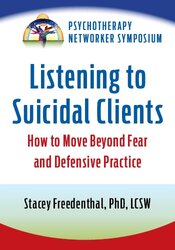
Listening to Suicidal Clients: How to Move Beyond Fear and Defensive Practice
- Speaker:
- Stacey Freedenthal, PhD, LCSW
- Duration:
- 1 Hour 57 Minutes
- Language:
- Presented in EN, subtitles in EN, ES, DE, IT, and FR, handouts in EN, ES, DE, IT, and FR
- Copyright:
-
30 Mar, 2022
- Product Code:
- NOS096195
- Media Type:
- Digital Seminar

Description
One of therapists’ greatest fears is losing a client to suicide. That’s not surprising, considering the grief and self-doubt that can follow, plus the possibility of a lawsuit or board complaint. The fear of client suicide can lead to “defensive practice,” in which therapists interrogate clients about their suicidal thoughts, pursue emergency care when it’s not truly needed, or take other actions to protect themselves legally and emotionally rather than to meet the clients’ needs. In this recording, you’ll learn to:
- Understand healthy versus unhealthy fears about client suicide
- Identify client-centered rather than fear-based practices with someone who has suicidal thoughts
- Work as an ally, not an adversary, when a client is at risk for suicide
- Feel less afraid and anxious with clients who have suicidal thoughts
Credit
Speaker

Stacey Freedenthal, PhD, LCSW Related seminars and products
Stacey Freedenthal, PhD, LCSW, is an educator, psychotherapist, and writer specializing in helping people who experience suicidal thoughts or behavior. She’s authored two books: Helping the Suicidal Person: Tips and Techniques for Professionals (Routledge; 2018) and Loving Someone with Suicidal Thoughts: What Family, Friends, and Partners Can Say and Do (New Harbinger; 2023). Dr. Freedenthal also created the website Speaking of Suicide, and she has authored or co-authored more than 40 peer-reviewed articles and book chapters about suicidality and related topics.
Dr. Freedenthal is an associate professor at the University of Denver Graduate School of Social Work, and a psychotherapist and consultant in private practice. She started working in suicide prevention in 1995, as a volunteer for a suicide hotline. After earning a master’s degree in social work from the University of Texas, she worked in various psychiatric emergency settings before earning her Ph.D. in social work at Washington University in St. Louis. She has been on the DU faculty since 2005, where she teaches classes on suicide assessment and interventions, clinical social work practice, and social justice challenges in mental health practice.
Speaker Disclosures:
Financial: Dr. Stacey Freedenthal is a psychotherapist and consultant in private practice and has an employment relationship with the University of Denver. She has a family member with an employment relationship with LivingWorks. She receives royalties as a published author. Dr. Freedenthal receives a speaking honorarium and recording royalties from Psychotherapy Networker and PESI, Inc. She has no relevant financial relationships with ineligible organizations.
Non-financial: Dr. Stacey Freedenthal is a member of the International Association of Suicide Prevention, the National Association of Social Workers, and the American Association of Suicidology. She uses CBT, CAMS, ACT, and other evidence-based suicide prevention strategies in her presentation.
Additional Info
Program Information
Access for Self-Study (Non-Interactive)Access never expires for this product.
For a more detailed outline that includes times or durations of time, if needed, please contact cepesi@pesi.com
Objectives
- Evaluate the concept of “defensive practice” in the context of treating clients at risk for suicide.
- Analyze at least four fear-based practices often used with clients who have suicidal thoughts.
- Practice at least four client-centered practices for use with clients who have suicidal thoughts.
- Assess at least two ways that therapists can improve their competency when working with clients at risk for suicide.
Outline
- Fears that commonly occur when therapists work with a client who has suicidal thoughts
- Understanding the issues with “Defensive practice”
- Examples of defensive practice & other fear-based techniques with suicidal clients
- Examples of client-centered practice with suicidal clients
- Practices for managing fear with suicidal clients
Target Audience
- Psychologists
- Physicians
- Addiction Counselors
- Counselors
- Social Workers
- Marriage & Family Therapists
- Art Therapists
- Nurses
- Other Behavioral Health Professionals
Reviews
| 5 |
|
| 4 |
|
| 3 |
|
| 2 |
|
| 1 |
|
Overall: 4.8
Total Reviews: 148
Satisfaction Guarantee
Your satisfaction is our goal and our guarantee. Concerns should be addressed to info@pesi.eu.
Please wait ...