


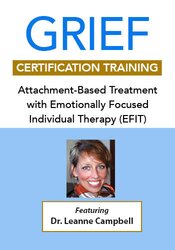
Grief Certification Training: Attachment-Based Treatment with Emotionally Focused Individual Therapy (EFIT)
- Speaker:
- Leanne Campbell, PhD
- Duration:
- 12 Hours 40 Minutes
- Language:
- Presented in EN, subtitles in EN, ES, DE, IT, and FR, handouts in EN, ES, DE, IT, and FR
- Copyright:
-
24 Feb, 2025
- Product Code:
- POS150009
- Media Type:
- Digital Seminar

Description
There may not be a roadmap for grieving …
… but there IS one for transformational, evidence-based grief treatment!
Where other grief approaches rely on integrative strategies that sometimes feel random and disconnected, EFIT provides a set of practical, easy-to-use interventions rooted in attachment science to guide clients from loss into growth and resilience.
Based on Dr. Sue Johnson’s groundbreaking work, EFIT is a comprehensive approach that helps you widen your client’s window of tolerance for emotion, shift negative coping cycles, work with core vulnerabilities, unblock barriers to the natural grief process, and more.
And now you can learn EFIT directly from Dr. Leanne Campbell, training partner and co-author with the late Dr. Sue Johnson of A Primer for Emotionally Focused Therapy, who has trained tens of thousands of clinicians in this powerful approach.
Through a carefully curated mix of didactic instruction and moving case examples, Dr. Campbell will show you how to create powerful corrective emotional experiences to transform the intensely painful emotions that threaten to overwhelm your clients.
Best of all, this training will give you the knowledge and tools you need to become a Certified Grief Informed Professional* - and we’ll cover the cost of your application fee!
Whether you’re treating anticipatory grief, traumatic grief, or even non-death losses, you’ll get a flexible approach that moves clients toward resilience and growth, all while earning certification.
PURCHASE TODAY!
*Professional standards apply. Visit eu.evgcert.com/cgp for professional requirements.
CERTIFICATION MADE SIMPLE
- No hidden fees – PESI pays for your application fee (a $99.99 USD value)!
- Simply watch the video and the post-event evaluation included in this training, and your application to be a Certified Grief Informed Professional through Evergreen Certifications is complete*
Attendees will receive documentation of CGP designation from Evergreen Certifications 4 to 6 weeks following the program.
*Professional standards apply. Visit eu.evgcert.com/cgp for professional requirements.
Credit
Speaker

Leanne Campbell, PhD Related seminars and products
Leanne Campbell, PhD, is co-developer of Emotionally Focused Individual Therapy (EFIT) and co-author with Dr. Susan Johnson of the first basic EFIT text, A Primer for Emotionally Focused Individual Therapy (EFIT). She also co-authored Emotionally Focused Therapy for Trauma and contributed to Becoming an Emotionally Focused Therapist: The Workbook.
Dr. Campbell is a registered psychologist in the province of British Columbia, vice president of the International Center for Excellence in Emotionally Focused Therapy (ICEEFT), and an international speaker, writer, researcher, trainer and co-author of various EFT-related educational programs and materials. In addition to providing psychological services to hundreds of individuals, couples, and families over nearly three decades, Dr. Campbell provides trainings in Emotional Focused Therapy (EFT) to professionals around the globe with a primary focus in the areas of loss and trauma. Dr. Campbell’s dedication to advancing EFT principles and her commitment to helping others grow through emotionally focused interventions have made her a foremost authority in the field.
Speaker Disclosures:
Financial: T. Leanne Campbell maintains a private practice and receives royalties as a published author. She receives a speaking honorarium, recording, and book royalties from Psychotherapy Networker and PESI, Inc. She has no relevant financial relationships with ineligible organizations.
Non-financial: T. Leanne Campbell is a board member International Centre for Excellence in Emotionally Focused Therapy. She is a member of the Canadian Psychological Association, the College of Psychologists of British Columbia, and the International Centre for Excellence in Emotionally Focused Therapy.
Additional Info
Program Information
Access for Self-Study (Non-Interactive)Access never expires for this product.
For a more detailed outline that includes times or durations of time, if needed, please contact cepesi@pesi.com.
Objectives
- Identify the attachment perspective on emotional health.
- Define the features of complicated and prolonged grief.
- Differentiate the role of the therapist in EFIT with grieving clients.
- Develop a therapeutic alliance utilizing principles from attachment science.
- Utilize attachment theory principles to conduct a case conceptualization for grief.
- Identify barriers to the natural grief process.
- Evaluate the three stages of the EFIT model to inform clinical treatment interventions for grief-related symptoms.
- Choose three interventions focused on reflecting and understanding grief-related emotions.
- Utilize the CARE model to contextualize clients’ loss experiences withing their attachment history.
- Develop imaginal encounters to evoke adaptive emotion.
- Choose self-care strategies as a mental health professional working with grieving clients.
- Identify strategies to mitigate two ethical issues related to work with grieving clients.
Outline
Grief as Altered AttachmentHow the model known for love also deals with loss
- The attachment view of loss and love
- Continuing bonds after loss
- The view of self in relationship
- Organic model of growth and change
- Death, dying, and mourning
- Grief trajectories and the key role of resilience
- Implications for specific types of losses
- Anticipatory loss
- Traumatic loss
- Non-death loss
- The context of pre- and post-loss factors
- Normal grief, complicated grief, prolonged grief
Make assessments process-oriented and therapeutic
- The role of the therapist in EFIT
- Elements of a safe-haven alliance and how to create one
- Case conceptualization of grief from the EFIT model
- Help clients tell the story of their loss
- How to increase awareness and openness to emotion
- Identify emotional “handles”
- Top strategies for working with core vulnerability
- Attune to CARE – context, attachment, relationship, emotion
- Monitor and widen clients’ window of tolerance for emotion
- Pacing and safety considerations
- How to spot blocks in the grieving process
- Regret and guilt, forgiveness and reconciliation
- Developmental and life stage considerations
- Understand clients’ cultural identities
- The role of spirituality in grief
- Suicide risk assessment
EFIT stages and interventions
- The EFIT “Tango” sequence of macro interventions
- Key goals of stabilization during grief
- How to do reflections, reframes, and interpretations right
- Mirror and reflect the clients’ experience
- Assist clients in identifying and deepening grief-related emotion
- Choose key defining grief-related experiences to explore
- Create emotional balance with choreographed imaginal encounters
- Revise how clients see themselves and attachment figures
- Shift negative cycles of coping
- Case studies
- Walk alongside versus intervening
- Ethical and professional issues
- Boundaries of competence
- Work with children and families
- Grief in the terminally ill
- End-of-life decisions
- Self-care for the grief professional
- Limitations of the research and potential risks
Target Audience
- Counselors
- Social Workers
- Psychologists
- Psychotherapists
- Psychiatrists
- Marriage & Family Therapists
- Addiction Counselors
- Other Mental Health Professionals
Reviews
Satisfaction Guarantee
Your satisfaction is our goal and our guarantee. Concerns should be addressed to info@pesi.eu.
Please wait ...