


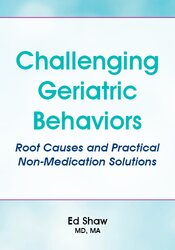
Challenging Geriatric Behaviors
Root Causes and Practical Non-Medication Solutions
- Speaker:
- Edward G. Shaw, MD, MA
- Duration:
- 1 Hour 55 Minutes
- Language:
- Presented in EN, subtitles in EN, ES, DE, IT, and FR, handouts in EN, ES, DE, IT, and FR
- Copyright:
-
26 Oct, 2021
- Product Code:
- POS078305
- Media Type:
- Digital Seminar

Description
Behavior challenges are some of the most difficult problems family care partners and professional caregivers face when caring for an aging loved one or a person living with dementia. You will learn about the root causes of behavior challenges, a framework to assess, prevent, and manage behaviors, and a number of other non-medication-based strategies that really work!
Credit
Handouts
| File type | File name | Number of pages | |
|---|---|---|---|
| Manual - Challenging Geriatric Behaviors (6.67 MB) | 41 Pages | Available after Purchase | |
| Manual - Challenging Geriatric Behaviors - French (6.67 MB) | 41 Pages | Available after Purchase | |
| Manual - Challenging Geriatric Behaviors - Italian (6.67 MB) | 41 Pages | Available after Purchase | |
| Manual - Challenging Geriatric Behaviors - German (6.67 MB) | 41 Pages | Available after Purchase | |
| Manual - Challenging Geriatric Behaviors - Spanish (6.67 MB) | 41 Pages | Available after Purchase |
Speaker
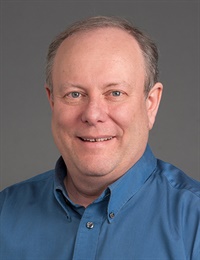
Edward G. Shaw, MD, MA Related seminars and products
Empath Education, LLC
Edward G. Shaw, MD, MA, is dually trained as a physician and mental health counselor. He was the primary care partner for his late wife, Rebecca, who was diagnosed with early-onset Alzheimer’s disease in 2007 at age 53 and died in 2016 after a 9-year journey. Ed was a practicing academic radiation oncologist for 23 years, specializing in the treatment of adults and children with brain cancer. In 2010, inspired by Rebecca’s journey, his medical interest shifted to dementia diagnosis and treatment, and with his additional training in mental health counseling, he founded the Memory Counseling Program in 2011, part of the Section on Gerontology and Geriatric Medicine and the Sticht Center on Healthy Aging and Alzheimer's Prevention at Atrium Health Wake Forest Baptist in Winston-Salem, North Carolina. The program serves individuals, couples, and families affected by Alzheimer’s disease or another type of dementia.
He is the author of four books. Along with coauthors Deborah Barr and Dr. Gary Chapman, he wrote Keeping Love Alive as Memories Fade: The 5 Love Languages and the Alzheimer’s Journey, which describes his moving personal story of care for Rebecca coupled with an innovative use of the 5 love languages in dementia counseling. He also wrote The Dementia Care Partner’s Workbook, a support group manual and self-study guide for dementia care partners, providing understanding, education, and hope for the long journey of dementia caregiving from diagnosis through end-of-life. He has also co-authored two resources for support group leaders, A Leader’s Manual for Dementia Care Partner Support Groups and A Support Group for People Living with Dementia: The Leaders Manual.
Dr. Shaw now devotes more time to public speaking, educating, and encouraging seniors, people living with dementia and their care partners, and medical/mental health/other healthcare professionals working in the fields of aging and dementia. He is also a part-time geriatric mental health counselor at New Salem Counseling in Winston-Salem and a PESI speaker for many years, on a variety of topics related to geriatrics and dementia.
Speaker Disclosures:
Financial: Dr. Edward Shaw is an Emeritus Professor with Wake Forest School of Medicine and receives a speaking honorarium and recording royalties from PESI, Inc. He has stock ownership in Embodied Labs. He has no relevant financial relationships with ineligible organizations.
Non-financial: Dr. Edward Shaw is a member of American Counseling Association, the American Society of Clinical Oncology, the American Society for Therapeutic Radiology and Oncology, and the Society for Neuro-Oncology.
Additional Info
Program Information
Access for Self-Study (Non-Interactive)Access never expires for this product.
For a more detailed outline that includes times or durations of time, if needed, please contact cepesi@pesi.com
Objectives
- Apply the three-component framework of geriatric and dementia-related behaviors to understand, prevent, and manage situations that occur in your practice setting.
- Differentiate between those behavior changes seen with normal aging and early-stage dementia to those typical of moderate- to late-stage dementia.
- Analyze the principles of attachment loss and separation distress to manage the most challenging geriatric behaviors safely, effectively, confidently, and compassionately.
Outline
Key Approaches to Geriatric/Dementia-Related Behaviors- Medical/mental health issues with the person
- Caregiver challenges
- Environmental causes
- Applying a new framework to clinical practice
- Secure and insecure attachment
- Separation distress
- Seeking and withdrawn responses
- Apathy
- Lack of insight/denial
- Impaired judgment
- Repetitive and persistent behaviors
- Lost identity
- Delusions and hallucinations
- Behavioral disinhibition
- Obsessive/compulsive behaviors and hoarding
- Agitation and aggression
- Wandering
- Sexual behaviors
- Resisting care
- Sundowning
- Refusing to eat and other nutrition issues
- Insomnia, day/night reversal, and other sleep issues
- Acknowledge/affirm/redirect
- Keep it short/simple/safe
- Reminiscence approaches
- Mindfulness
Target Audience
- Nurses
- Nurse Practitioners
- Clinical Nurse Specialists
- Physician Assistants
- Physicians
- Physical Therapists
- Physical Therapist Assistants
- Occupational Therapists
- Occupational Therapy Assistants
- Speech Language Pathologists
- Social Workers
- Nursing Home Administrators
Reviews
Satisfaction Guarantee
Your satisfaction is our goal and our guarantee. Concerns should be addressed to info@pesi.eu.
Please wait ...