


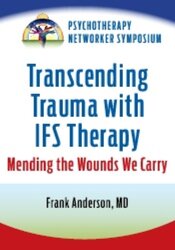
Transcending Trauma with IFS Therapy: Mending the Wounds We Carry
- Speaker:
- Frank Anderson, MD
- Duration:
- 4 Hours 01 Minutes
- Language:
- Presented in EN, subtitles in EN, ES, DE, IT, and FR, handouts in EN, ES, DE, IT, and FR
- Copyright:
-
11 Mar, 2022
- Product Code:
- NOS096190
- Media Type:
- Digital Seminar

Description
Hopeless, anxious, isolated. For many clients with complex PTSD, life can be a draining march of negative feelings and rejection. And for the therapists who treat them, it’s often difficult to cultivate hope while addressing trauma-related volatility and vulnerability. Fortunately, incorporating Internal Family Systems techniques into treatment has been shown to reduce relational trauma and early attachment wounds, allowing therapists to create that elusive, hopeful path forward. In this session, you’ll discover how to:
- Unload distorted thoughts and beliefs; discharge troubling physical sensations; and release feelings of unworthiness, loneliness, and unlovability
- Address protective client parts in a trauma-specific manner, and gain their permission to access hidden vulnerabilities
- Clarify which cognitive, body-centered, and emotional tools release deeply engrained pain
- Apply neuroscientific understanding to therapeutic decisions about extreme symptoms, and address common adaptations of relational trauma, like neglect, shame, and substance use
This product is not endorsed by, sponsored by, or affiliated with the IFS Institute and does not qualify for IFS Institute credits or certification.
Credit
Speaker

Frank Anderson, MD Related seminars and products
Frank Anderson, MD, completed his residency and was a clinical instructor in psychiatry at Harvard Medical School. He is both a psychiatrist and psychotherapist. He specializes in the treatment of trauma and dissociation and is passionate about teaching brain-based psychotherapy and integrating current neuroscience knowledge with the IFS model of therapy.
Dr. Anderson has lectured extensively on the Neurobiology of PTSD and Dissociation and wrote the chapter “Who’s Taking What” Connecting Neuroscience, Psychopharmacology and Internal Family Systems for Trauma in Internal Family Systems Therapy – New Dimensions. He co-authored a chapter on What IFS Brings to Trauma Treatment in Innovations and Elaborations in Internal Family Systems Therapy, and recently co-authored Internal Family Systems Skills Training Manual.
His most recent book, entitled Transcending Trauma: Healing Complex PTSD with Internal Family Systems was released on May 19, 2021.
His memoir, To Be Loved, was released on May 7, 2024.
Speaker Disclosures:
Financial: Dr. Frank Anderson maintains a private practice, is the co-founder of the Trauma Institute, and is the co-founding producer of Trauma Informed Media. He receives royalties as a published author. He receives a speaking honorarium, recording, and book royalties from PESI, Inc. He has no relevant financial relationships with ineligible organizations.
Non-financial: Dr. Frank Anderson is a member of the New England Society Studying Trauma and Dissociation and the International Society for the Study of Trauma and Dissociation.
Additional Info
Program Information
Access for Self-Study (Non-Interactive)Access never expires for this product.
For a more detailed outline that includes times or durations of time, if needed, please contact cepesi@pesi.com
Please Note
This product is not endorsed by, sponsored by, or affiliated with the IFS Institute and does not qualify for IFS Institute credits or certification.
Objectives
- Differentiate types of traumatic stress including those from early attachment ruptures.
- Distinguish the ways IFS is different from traditional phase-oriented treatments for traumatic stress.
- Demonstrate how IFS works with protective inner parts to access traumatic ruptures.
- Integrate IFS principles with other psychotherapeutic models of treatment.
- Evaluate common clinical setbacks to recovery from traumatic stress.
Outline
- Comparison of IFS with other models and phase-oriented treatments for trauma
- Understand risks and limitations of the approach
- Demonstrate how to identify and address clients’ protective parts
- How to gain permission from protective parts to access hidden vulnerabilities
- Differentiate between compassion and empathy and why both are important to trauma recovery
- The 6 F’s of trauma recovery in IFS and moving beyond the 6 F’s
- Addressing early attachment wounds, separation, and preverbal trauma
- Addressing dissociative and perpetrator parts
- Two subtypes of PTSD and how to address them differently
- Order of trauma recovery
- Common roadblocks to trauma recovery in clinical work
Target Audience
- Psychologists
- Physicians
- Addiction Counselors
- Counselors
- Social Workers
- Marriage & Family Therapists
- Art Therapists
- Nurses
- Other Behavioral Health Professionals
Reviews
| 5 |
|
| 4 |
|
| 3 |
|
| 2 |
|
| 1 |
|
Overall: 4.7
Total Reviews: 239
Satisfaction Guarantee
Your satisfaction is our goal and our guarantee. Concerns should be addressed to info@pesi.eu.
Please wait ...