


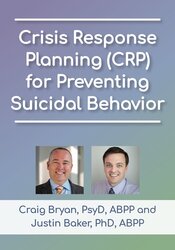
Crisis Response Planning (CRP) for Preventing Suicidal Behavior
- Speakers:
- Craig J. Bryan, PsyD, ABPP | Justin Baker, PhD, ABPP
- Duration:
- 2 Hours 16 Minutes
- Language:
- Presented in EN, subtitles in EN, ES, DE, IT, and FR, handouts in EN, ES, DE, IT, and FR
- Copyright:
-
31 May, 2022
- Product Code:
- NOS096264
- Media Type:
- Digital Seminar

Description
The crisis response plan (CRP) is a brief intervention designed to prevent suicidal behavior in at-risk individuals. Results of a recently-completed randomized clinical trial support the efficacy of CRP as compared to treatment as usual, and indicate the CRP reduced suicide attempts by 76% as compared to treatment as usual. This half-day workshop is designed to enhance participants’ knowledge about crisis response planning for managing acute suicide risk, and to increase their ability to confidently and competently administer this intervention with at-risk military personnel. The workshop includes video demonstrations designed for participants to acquire skill competency. All participants will receive a pocket handbook providing tips and suggestions for effective use of the CRP after training.
Credit
Speaker

Craig J. Bryan, PsyD, ABPP Related seminars and products
Dr. Craig J. Bryan, PsyD, ABPP, is a board-certified clinical psychologist in cognitive behavioral psychology. He is the Stress, Trauma, and Resilience (STAR) Professor of Psychiatry and Behavioral Health at The Ohio State University Wexner Medical Center and is the division director for recovery and resilience. Dr. Bryan received his PsyD in clinical psychology in 2006 from Baylor University and completed his clinical psychology residency at the Wilford Hall Medical Center, Lackland Air Force Base, TX. Dr. Bryan deployed to Iraq in 2009, where he served as the Director of the Traumatic Brain Injury Clinic at the Air Force Theater Hospital. He separated from active-duty service shortly after his deployment, and started researching PTSD, suicidal behaviors and suicide prevention strategies, and psychological health and resiliency. He has held faculty appointments at the University of Texas Health San Antonio, the University of Utah, and The Ohio State University College of Medicine, and has managed numerous federally funded projects in excess of $30 million focused on testing treatments for reducing suicidal behaviors, developing innovative methods to identify and detect high-risk individuals, and facilitating recovery after trauma. Dr. Bryan has published hundreds of peer-reviewed scientific articles and his research has been funded by a wide range of agencies including the Department of Defense, the National Institutes of Health, the Boeing Company, the Bob Woodruff Foundation, and the Navy SEAL Foundation, and has been featured in media outlets including Scientific American, CNN, Fox News, NPR, USA Today, the LA Times, the New York Times and the Washington Post. Dr. Bryan has published over 250 scientific articles and multiple books including Brief Cognitive Behavioral Therapy for Suicide Prevention and Rethinking Suicide.
Dr. Bryan has served as the lead risk management consultant for the $25 million STRONG STAR Research Consortium and the $45 million Consortium to Alleviate PTSD, which investigates treatments for combat-related PTSD among military personnel. Dr. Bryan has served on the Board of Directors of the American Association for Suicidology, the Scientific Advisory Board for the Navy SEAL Foundation, the Educational Advisory Board of the National Center for PTSD, and as a member of the Department of Defense Suicide Prevention and Response Independent Review Committee (SPRIRC). For his contributions to mental health and suicide prevention, Dr. Bryan has received numerous awards and recognitions including the Arthur W. Melton Award for Early Career Achievement, the Peter J.N. Linnerooth National Service Award, and the Charles S. Gersoni Military Psychology Award from the American Psychological Association, and the Edwin S. Shneidman Award for outstanding contributions to research in suicide from the American Association of Suicidology. He is an internationally recognized expert on suicide prevention, trauma, and resilience.
Speaker Disclosures:
Financial: Dr. Craig Bryan has employment relationships with the University of Vermont and Canandaigua VA Medical Center. He receives royalties as a published author. Dr. Bryan receives contracts from the National Institute of Mental Health and the Department of Defense. He is a consultant/trainer for Federal Bureau of Prisons and a consultant for Strong Star Research Consortium and Substance Abuse and Mental Health Services Administration National Advisory Council. Dr. Bryan receives a speaking honorarium and recording royalties from Psychotherapy Networker and PESI, Inc. He has no relevant financial relationships with ineligible organizations.
Non-financial: Dr. Craig Bryan is a member of the American Association for Suicidology, the American Psychological Association, the Association for Behavioral and Cognitive Therapies, Utah Psychological Association, and the International Association for Suicide Prevention. He is an ad hoc reviewer and editor for several peer review journals, for a complete list contact PESI, Inc.

Justin Baker, PhD, ABPP Related seminars and products
Justin C. Baker, PhD, ABPP, is an assistant professor in the department of psychiatry and behavioral health at The Ohio State University and the clinical director for the Suicide and Trauma Reduction Initiative (STRIVE), a research and clinical treatment program that prioritizes evidence-based treatment for veterans, first responders, and civilians suffering from trauma and/or suicide. He is a board-certified clinical psychologist and military veteran focused on improving interventions for trauma and suicide-related disorders. His work has been funded by the Department of Defense and other private foundations. Dr. Baker is also a national consultant and sought out trainer for suicide-focused treatments. A recent recipient of the Henry A. and Amelia T. Nasrallah Award for Research Excellence in Psychiatry and Behavioral Health, his work has been featured in various media outlets to include CNN, Psychiatric Times, CBS, ABC News, CNN Health, NPR, The American Homefront Project, Yahoo, and US News & World Report.
Speaker Disclosures:
Financial: Justin Baker has employment relationships with the Ohio State Wexner Medical Center STRIVE. He is the Principal Investigator with the Department of Defense, and the co-Investigator for PCORI, the Department of Defense Air Force, and Department of Defense PRMRP. He receives a speaking honorarium and recording royalties from Psychotherapy Networker and PESI, Inc. He has no relevant financial relationships with ineligible organizations.
Non-financial: Justin Baker is a member of American Psychological Association. He is an ad-hoc reviewer for several publications, for a complete list contact PESI, Inc. He serves as a community action board member for PTSD, Suicide Risk, and TBI at the University of Pennsylvania.
Additional Info
Program Information
Access for Self-Study (Non-Interactive)Access never expires for this product.
Objectives
- Categorize the four primary purposes of a crisis response plan.
- Conduct a functional assessment of the internal and external motivators of suicidal behaviors.
- Appraise the three levels of suicide risk.
- Construct a crisis response plan and demonstrate how to implement the plan with a client.
Outline
- Conceptual foundation
- What a crisis plan is and is not
- Scientific evidence
- Understanding suicidal behaviors
- Steps for the crisis response plan
- Narrative assessment
- Crisis response plan components
- Demonstration
- Participant practice and role play
Target Audience
- Counselors
- Social Workers
- Psychologists
- Psychotherapists
- Therapists
- Marriage & Family Therapists
- Addiction Counselors
- Case Managers
- Physicians
- Nurses
- Other Mental Health Professionals
Reviews
| 5 |
|
| 4 |
|
| 3 |
|
| 2 |
|
| 1 |
|
Overall: 4.8
Total Reviews: 966
Satisfaction Guarantee
Your satisfaction is our goal and our guarantee. Concerns should be addressed to info@pesi.eu.
Please wait ...