


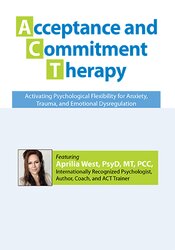
Acceptance and Commitment Therapy: Activating Psychological Flexibility for Anxiety, Trauma, and Emotional Dysregulation
- Speaker:
- Aprilia West, PsyD, MT, PCC
- Duration:
- 6 Hours 24 Minutes
- Language:
- Presented in EN, subtitles in EN, ES, DE, FR, and IT, handouts in EN, ES, DE, FR, and IT
- Copyright:
-
26 Apr, 2024
- Product Code:
- POS059090
- Media Type:
- Digital Seminar

Tags: APA
Description
Getting stuck when working with clients who are psychologically inflexible is a normal experience for therapists. But it can often feel like fighting a losing battle where, despite your most powerful clinical tools, there is little to no real progress.
This often happens because, in addition to knowing WHAT to do to expand your client’s behavioral repertoire, you also need the skills and confidence to know HOW to create the context for real learning to happen.
While many clinicians learn and understand the basics about ACT, they often lack confidence when it comes to disrupting psychological inflexibility in session.
In this 1-day training Dr. Aprilia West, MT, PCC, takes you all the way through the ACT model using process-based cognitive-behavioral strategies to accelerate psychological flexibility across a wide range of diagnoses and improve client outcomes.
By learning to make expert-level therapeutic moves with ACT you can help clients decrease suffering and live a more meaningful life -- regardless of their diagnosis or level of functioning. This ACT workshop will help you enhance your ability to work with common clinical presentations including:
- Chronic Stress, Anxiety and Depression
- Emotional Reactivity and Emotional Dysregulation
- Unprocessed Trauma/PTSD
- Substance Abuse and Compulsive Behaviors
Credit
Speaker

Aprilia West, PsyD, MT, PCC Related seminars and products
Aprilia West, PsyD, MT, PCC, is an internationally recognized psychologist, coach, trainer, author, and expert in the field of psychotherapy and coaching. Dr. West has trained thousands of therapists and coaches in applying contextual behavioral science worldwide. She is former president of the Association for Contextual Behavioral Science (ACBS), Southern California chapter, part of the international ACT organization with over 8,000 members worldwide.
In addition, Dr. West is known for developing the construct of emotional efficacy, an integration of emotional intelligence, psychological flexibility, and resilience. She also developed and piloted an evidence-based protocol, Emotion Efficacy Therapy (EET), which combines novel emotion psychoeducation with components of Acceptance and Commitment Therapy (ACT), Dialectical Behavior Therapy (DBT) and exposure therapy.
Dr. West is author of ACT for Your Best Life (2023), What You Feel Is Not All There Is (2021), coauthor of Acceptance and Commitment Coaching in the Workplace, (Springer 2021) and The Clinician’s Guide to Emotion Efficacy Therapy (2016).
Dr. West is a fellow with the Institute of Coaching, McLean, affiliate of Harvard Medical School, is credentialed as a professional certified coach (PCC) through the International Coaching Federation, and has additional training and certifications including: the Leadership Circle Profile 360 assessments, Systemic Team Coaching through the Academy of Executive Coaching, mediation and conflict resolution and through the Harvard Law School Program on Negotiation (PON), Positive Psychology and Wellbeing Coaching from the College of Executive Coaching, and coach training from the Coactive Training Institute (CTI).
Speaker Disclosures:
Financial: Aprilia West maintains a private practice. She receives royalties as a published author and is a research advisor for Emotion Efficacy Training. Aprilia West receives a speaking honorarium, recording, and book royalties from PESI, Inc. She has no relevant financial relationships with ineligible organizations.
Non-financial: Aprilia West is a member of the American Psychological Association, the International Coaching Federation, and the Association for Behavioral and Cognitive Therapies.
Additional Info
Program Information
Access for Self-Study (Non-Interactive)Access never expires for this product. For a more detailed outline that includes times or durations of time, if needed, please contact cepesi@pesi.com.
Questions?
Visit our FAQ page at www.pesi.com/faq or contact us at www.pesi.com/info
Objectives
- Identify core underlying processes related to mental health and wellbeing.
- Distinguish between the 6 psychological flexibility processes in the ACT hexaflex model.
- Apply “open” skills to address experiential avoidance and past and/or future focus.
- Utilize “aware” skills to address over identification with self as content and cognitive fusion.
- Demonstrate “engage” skills to address lack of meaning and purposeful action in context.
- Conduct experiential exercises to enhance the learning, retention and recall of new ACT skills.
Outline
Acceptance and Commitment Theory: The myth of “normal”- What does wellbeing look like?
- The Human Condition: Pain vs suffering
- Why Acceptance and Commitment Therapy?
- The problem of avoidance: the Inflexahex model
- How ACT is different from other approaches
- Evidence of ACT
- Limitations of the research and potential risks
- The power of anchoring in the present
- Common obstacles to Present Moment Awareness
- Metaphor for PMA: Your experience of a musical band
- PMA experientials to contact the “here and now”
- Watching experiential STUF
- Turning into 5 senses
- Case example: A veteran presenting with unprocessed trauma
- The opposite of control
- What’s possible with non-reactivity
- Acceptance of painful emotions and realities
- What acceptance is not
- Obstacles to acceptance
- Metaphor for acceptance: The blow-up ball in a swimming pool
- Acceptance experientials:
- Dropping the rope
- Audio exposure
- Case example: A performing artist presenting with avoidance of social situations
- Benefits of holding thoughts lightly
- The power of language
- Obstacles to defusion
- Metaphor for defusion: The mind as a 24/7 streaming station
- Defusion experiential:
- “ My mind made up the thought that….”
- Don’t do what I say
- Case example: A stay at home mother presenting with hopeless thinking
- 3 levels of ‘selfing’
- Benefits of flexible perspective taking
- Obstacles to Self as Context
- Metaphor for Self as Context: Sky and weather as observer and experience
- SAF experientials:
- I am
- Prosecute yourself
- Case example: A CEO presenting with rigid thinking patterns
- The power of values
- Values vs. scripts or goals
- Obstacles to clarifying values
- Values clarification
- Values-based action plan
- Metaphors for clarifying values:
- Jar of fullness
- The Scoreboard
- Case example: A grad student presenting with a lack of clear direction and meaning
- Benefits of values-based moves
- Pivoting from default to intention
- Using functional inquiry to stay on track
- Obstacles to committed action
- Committed action metaphor:
- Monsters on the Bus
- Committed action experiential:
- Creating a committed action plan
- Imaginal rehearsal of targeted behavior in context
- Case example: A couple presenting with avoidance of conflict
- Embodying ACT to be a psychologically flexible clinician
- Workability as a guide
- ACT case conceptualization
- Pop culture examples
- Integrating other therapies with ACT:
- Dialectical Behavioral Therapy
- Exposure therapy
- Schema therapy
- Common obstacles to PF in therapy
- Case example: A public figure presenting with compulsion to use drugs
Target Audience
- Social Workers
- Counsellors
- Psychologists
- Physicians
- Marriage and Family Therapists
- Addiction Counsellors
- Psychotherapists
- Case Managers
- Nurses
- Mental Health Professionals
- Therapists
- Other Mental Health Professionals
Reviews
Satisfaction Guarantee
Your satisfaction is our goal and our guarantee. Concerns should be addressed to info@pesi.eu.
Please wait ...