


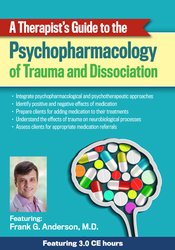
A Therapist’s Guide to the Psychopharmacology of Trauma and Dissociation
- Speaker:
- Frank Anderson, MD
- Duration:
- 3 Hours
- Language:
- Presented in EN, subtitles in EN, ES, DE, IT, and FR, handouts in EN, ES, DE, FR, and IT
- Copyright:
-
11 Sep, 2019
- Product Code:
- POS052688
- Media Type:
- Digital Seminar

Description
Let’s face it – treating trauma is hard work and it’s not always clear what needs to be done. Dysregulated nervous systems, co-morbidities, and a myriad of psychotherapeutic and psychopharmacological options often make it difficult to reach the desired goals for your clients.
Even though you may not be a prescriber of medications, it’s essential that you have a thorough understanding of the effects medication has in treating trauma.
Watch world renowned trauma expert Frank Guastella Anderson, MD, in this recording as he guides you through the essentials of Psychopharmacology related to the treatment of Trauma and Dissociation.
Dr. Anderson will teach you how to:
- Integrate psychopharmacological and psychotherapeutic approaches
- Identify positive and negative effects of medication
- Prepare clients for adding medication to their treatments
- Understand the effects of trauma on neurobiological processes
- Assess clients for appropriate medication referrals
Improve your outcomes through the understanding and application of the interplay between medications, psychotherapy and trauma.
Credit
Speaker

Frank Anderson, MD Related seminars and products
Frank Anderson, MD, completed his residency and was a clinical instructor in psychiatry at Harvard Medical School. He is both a psychiatrist and psychotherapist. He specializes in the treatment of trauma and dissociation and is passionate about teaching brain-based psychotherapy and integrating current neuroscience knowledge with the IFS model of therapy.
Dr. Anderson has lectured extensively on the Neurobiology of PTSD and Dissociation and wrote the chapter “Who’s Taking What” Connecting Neuroscience, Psychopharmacology and Internal Family Systems for Trauma in Internal Family Systems Therapy – New Dimensions. He co-authored a chapter on What IFS Brings to Trauma Treatment in Innovations and Elaborations in Internal Family Systems Therapy, and recently co-authored Internal Family Systems Skills Training Manual.
His most recent book, entitled Transcending Trauma: Healing Complex PTSD with Internal Family Systems was released on May 19, 2021.
His memoir, To Be Loved, was released on May 7, 2024.
Speaker Disclosures:
Financial: Dr. Frank Anderson maintains a private practice, is the co-founder of the Trauma Institute, and is the co-founding producer of Trauma Informed Media. He receives royalties as a published author. He receives a speaking honorarium, recording, and book royalties from PESI, Inc. He has no relevant financial relationships with ineligible organizations.
Non-financial: Dr. Frank Anderson is a member of the New England Society Studying Trauma and Dissociation and the International Society for the Study of Trauma and Dissociation.
Additional Info
Program Information
Access for Self-Study (Non-Interactive)Access never expires for this product.
For a more detailed outline that includes times or durations of time, if needed, please contact cepesi@pesi.com.
Objectives
- Integrate psychopharmacological and psychotherapeutic approaches in the treatment of trauma and dissociation.
- Determine the positive and potentially negative effects of psychoactive medication interventions related to trauma treatment.
- Prepare clients effectively for the implementation of psychopharmacological adjuncts to psychotherapy.
- Analyze the neurobiological effects of trauma to the dysregulation of neurotransmitters and the use of mitigating medications.
- Assess therapeutic indications for appropriate medication referrals.
Outline
- Effectively approaching traumatized clients with medication supports
- Classification of the different types of trauma
- Normative responses
- Iatrogenic risks of rapid psychopharmacological treatment
- Introduction to Internal Family Systems (IFS)
- Working with “parts of self” and medication interventions
- Primary types of parts
- Therapists’ role in medications – facilitating compliance
- Indications for medication referrals
- Integrating IFS with medication management
- Video case example – securing parts agreement and clarifying expectations
- Neuroscience and the neurobiology of PTSD
- Neural networks and neural integration
- Fear response circuitry – normal and disrupted function
- Neurotransmitters and medications
- Specific effects of most commonly used medication interventions
- Treating Acute Trauma
- Current psychopharmacological research and new directions
- Negative effects of benzodiazepine use
- Treating PTSD
- Indicated medications and common side effects
- Psychedelic assisted psychotherapy
- Enhancing self-compassion and reducing defenses
- Limitations of current research
- Hormones and PTSD
- Polyvagal theory and Dissociation
- Differentiating ventral and dorsal parasympathetic function
- Treating Dissociation – applications of atypical antipsychotics
- Medications new to the market
- Psychosis, Bipolar Disorder and Trauma - Co-morbidities and Trauma
- Use of PRN medications and scheduling
- Discriminating between biological and emotional symptoms
- Sleep disturbances
- Psychotropics used – effects and side effects
- Attention Deficit Disorder – overlap and medication interaction with PTSD
- Substance abuse and indicated medications
- Depression and co-morbid PTSD
- Star-D study results
- Polypharmacy for PTSD symptomology
- OCD
- Alternative treatments for Trauma
Target Audience
- Addiction Counselors
- Case Managers
- Counselors
- Marriage & Family Therapists
- Nurses
- Pharmacists
- Psychologists
- Social Workers
- Other Mental Health Professionals
Reviews
| 5 |
|
| 4 |
|
| 3 |
|
| 2 |
|
| 1 |
|
Overall: 5
Total Reviews: 2
Satisfaction Guarantee
Your satisfaction is our goal and our guarantee. Concerns should be addressed to info@pesi.eu.
Please wait ...