Innovations in Psychotherapy: PESI Europe


Trauma is not just an event. It lives in the body, in how clients experience themselves, and in the broader world around them. This day expands the way you conceptualise what your clients are carrying, and why.

Presented in IT · Live interpretation in EN, ES, FR, DE
A history of traumatic attachment (TA) is a significant driver of treatment resistance, regardless of the presenting disorder or the therapeutic approach used. Among the many obstacles TA creates, difficulties in the therapeutic alliance are among the hardest to navigate. This session examines the typical alliance challenges that arise with patients who have a TA history and sets out clear principles for working through them.
Learning objectives
1. Identify the clinical difficulties specific to patients with a history of traumatic attachment;
2. Understand the obstacles to building and maintaining a stable therapeutic alliance;
3. Apply therapeutic principles for working through alliance difficulties in practice.

Presented in ES · Live interpretation in EN, FR, IT, DE
Medical training rarely teaches us to ask about a patient's trauma history. Yet many chronic conditions — persistent pain, functional symptoms, presentations that don't respond to standard treatments — may be rooted in early relational experiences that have left a mark on the body. The result is a gap in care. Patients move from one specialist to the next without anyone connecting the dots between what is happening to them and what has happened to them. This presentation makes the case for integrating a trauma-informed perspective into everyday clinical practice. The aim is not to turn every clinician into a psychotherapist, but to offer recognition frameworks, questions that open conversations, and a model for collaborative working that makes meaningful intervention possible. When a clinician knows how to look, a patient stops being an unexplained symptom and starts being heard.
Learning objectives
- Understand the mechanisms by which early traumatic experiences can manifest as somatic illness, drawing on current clinical research.
- Incorporate trauma history screening into general healthcare settings, supporting early identification and appropriate referral.
- Build an interdisciplinary collaboration framework between health and psychotherapy professionals for the integrated care of patients with possible trauma-origin somatic presentations.

Presented in EN · Live interpretation in ES, FR, IT, DE
Across Europe, clinicians are increasingly called to recognise and respond to the less visible dimensions of trauma — those shaped by identity, belonging and lived experience in diverse cultural and social contexts.
Yet many traditional trauma models still struggle to account for these layers, leaving important aspects of patients' experience inadequately addressed. The result is a clinical landscape in which genuinely integrative, context-sensitive care remains hard to achieve.
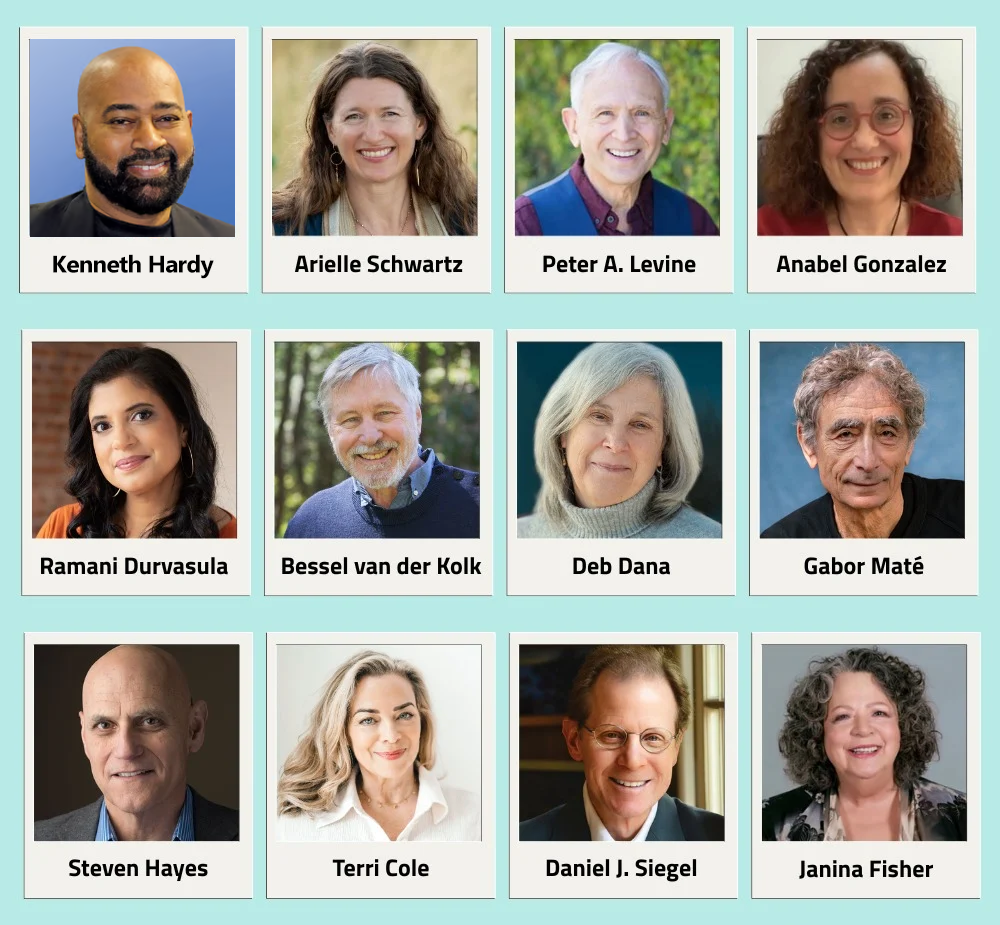
Drawing on more than three decades of work as a supervisor, teacher and author, Dr Kenneth Hardy has been a leading voice in expanding how we understand trauma — not as a discrete event, but as an experience deeply interwoven with relational, cultural and social dynamics.
In this presentation, he will examine how trauma intersects with identity and context, and how these dimensions shape both suffering and resilience. He will also offer concrete clinical reference points to help practitioners develop a more nuanced, inclusive and effective approach — one that meets the full humanity and complexity of the people they work with.

Presented in EN · Live interpretation in ES, FR, IT, DE
Trauma does not reside in thoughts or narratives, but in the body. When survival responses — fight, flight, freeze or collapse — are not completed, they remain physiologically encoded, keeping patients anchored in the past regardless of how much they have talked about what happened or how much insight they have gained. Dr Levine, a pioneer in somatic trauma therapy, offers a naturalistic and neurobiological framework for identifying where patients become "stuck" in defensive states, and for gently releasing the thwarted survival energy that underlies trauma symptoms. Through presentation and clinical case examples, you will acquire practical somatic tools to help your patients move out of chronic dysregulation and towards greater presence, resilience and calm. You will learn how to:
- Identify where a patient is physiologically stuck in a survival response
- Apply foundational somatic techniques including somatic tracking, titration and pendulation
- Support patients in developing self-regulation and co-regulation capacities
- Recognise the clinical risks specific to somatic work
Symptoms are rarely the whole story. This day explores how clients relate to their thoughts, emotions, and behaviours, why patterns persist even when clients want to change, and what actually creates lasting movement in therapy.

Presented in FR · Live interpretation in EN, ES, IT, DE
Why do some patterns hold firm even when a patient is doing everything they can to change them? The answer often lies not in insight or willpower but in emotional learnings stored deep in memory, learnings that quietly drive symptoms long after their original purpose has passed. In this session, Evelyne Josse explores memory reconsolidation, the brain's own mechanism for updating these learnings at their source. Drawing on her work in EMDR and hypnosis, she shows how these approaches can reactivate an old emotional memory and open a brief window in which genuine, lasting change becomes possible. You will see why symptom-focused work can leave the underlying pattern intact, and you will leave with practical strategies from both approaches, along with clear reference points for putting them to work in session.

Presented in ES · Live interpretation in EN, FR, IT, DE
Emotional regulation sits at the intersection of adverse experience and the development of later psychopathology. Far from a simple mechanism, it encompasses a complex set of processes that must be understood in depth to effectively address trauma-related disorders. This presentation examines the primary forms of emotional regulation and their clinical implications.
Learning objectives
1. Understand the key processes involved in emotional regulation in trauma, and their role in the development of psychopathology;
2. Identify different regulatory styles and difficulties in patients with a trauma history, particularly in complex presentations;
3. Apply practical clinical strategies to support emotional regulation in therapeutic work with traumatised patients.

Presented in EN · Live interpretation in ES, FR, IT, DE
The debate about narcissism has exploded on social media, in mental health forums and even in global politics. But when we bring the topic into the therapy room, what are we really talking about? Is narcissism a disorder? A personality style? An adaptive trait that drives success, or a maladaptive pattern that harms others? And why has this term become such a contentious topic in today's culture? We live in an era in which entitlement, grandiosity, status-seeking, arrogance and even gaslighting are socially and economically rewarded, while pointing out these traits and behaviours is often dismissed as punitive or pathologizing in healthcare settings, and even in global politics. But when we bring the topic back into the consulting room, what are we really treating?
In this provocative presentation, Dr Ramani Durvasula, New York Times bestselling author and expert on narcissism, clears up the confusion surrounding narcissism — which populates social media and pop psychology — to reveal the clinical reality. She will also unravel the ultimate clinical irony: while culture is obsessed with diagnosing narcissists, therapists tend to treat more of those who suffer from the conflictual patterns than those who cause the harm.

Presented in EN · Live interpretation in ES, FR, IT, DE
Women with ADHD often do not appear "hyperactive," but exhausted. They may seem responsible, organized, sociable and high-performing, yet often feel overwhelmed on the inside. Many present a mix of rejection sensitivity, emotional intensity, the need to please others, perfectionism and chronic guilt that has never been fully explained by traditional ADHD models. In this workshop, you will explore the Female ADHD Personality Profile, an emerging synthesis of research on neurodiversity, gender socialization, sensitivity, emotional labor, trauma history and lifelong masking. You will learn why women with ADHD often become over-strivers and people-pleasers, and why their relationships — parenting, romantic partnerships and friendships — are marked by patterns of excessive emotional responsibility and burnout. You will discover:
- Relationship-focused tools, including communication scripts, emotional regulation strategies, frameworks for setting boundaries and somatic and IFS-based interventions
- Ways to help women with ADHD build relationships that support neurodiversity
- How to translate cutting-edge research into practical, real-world strategies
- How to help patients overcome the burnout that stems from sensitivity, gender norms and rejection sensitivity
Some clients don't fit neatly into any one model. This day builds your capacity to work with more complex presentations, from personality and relational trauma to the clinical challenges that arise in real practice.

Presented in FR · Live interpretation in EN, ES, IT, DE
When a patient is overwhelmed by suffering and the work stalls, even seasoned clinicians can feel stuck. The alliance frays, resistance sets in, and the way forward becomes unclear. In this session, Isabelle Leboeuf brings together cognitive behavioural therapy, compassion-focused therapy and a systemic perspective to help you read these moments clearly and respond to them with confidence. You will come away with simple, practical tools and concrete clinical reference points you can put to use in session, so that even your most distressed patients feel met, understood and able to move forward.

Presented in DE · Live interpretation in EN, ES, FR, IT
Your most complex trauma clients don't just present with symptoms. They struggle with something deeper: a fractured sense of who they are. The usual tools track regulation and dysregulation, but they miss the real picture, because the fragmentation is held in the body itself.
Posture, breath, movement, and relational presence aren't only signs of a nervous system under strain. They're expressions of identity, shaped by every developmental rupture and trauma your client has lived through. Read them as such, and you gain a clinical lens most therapists never develop.
That's what this session gives you. Manuela Mischke-Reeds introduces Embodied Identity, a somatic framework that treats identity as a living, relational process rather than a fixed construct. Through case examples and brief experiential learning, you'll learn to recognise somatic markers of fragmentation, distinguish healthy multiplicity from trauma-related dissociation, and apply body-based interventions that move clients toward regulation, coherence, and embodied self-experience.

Presented in EN · Live interpretation in ES, FR, IT, DE
Many women carry father wounds without realising it. In our patriarchal culture, these wounds are reinforced, which makes them go unnoticed and hard to identify. Sometimes it is overt abuse, but more often there is a gradual accumulation of absences, emotional unavailability or disappointments that, over time, have become normal.
Whether the wound was obvious or subtle, these women may struggle to set boundaries, give too much in relationships or find it difficult to receive affection from others. They may feel anxious in the face of male authority or repeatedly choose partners who reinforce their deep fears about their own worth.
In this powerful session, the host of the widely followed podcast The Terri Cole Show and bestselling author of Boundary Boss, will draw on her latest book, Father Wound: Break Unhealthy Patterns to Reclaim Your Worth and Power, to help us better recognise father wounds in their many forms. She will also explore how untreated father wounds manifest in a woman's relationships, career and self-esteem, so that you can help your patients move from unconscious adaptation and self-abandonment towards greater self-confidence and more conscious relational choices.

Presented in EN · Live interpretation in ES, FR, IT, DE
Drawing on more than a decade of direct clinical experience working with people affected by severe addictions, mental illness and trauma, Gabor Maté offers a deeply human and scientifically grounded exploration of addiction in all its forms, from substance use to socially accepted compulsions, such as addiction to work, shopping and sex. Drawing on the latest advances in neuroscience and on his landmark book In the Realm of Hungry Ghosts, this workshop challenges conventional views of addiction as a genetic or purely medical disorder, presenting it instead as a continuum rooted in early childhood experiences, stress and emotional loss.
Through a compassionate lens, you will explore how early environments shape brain development, how stress and trauma increase vulnerability to addiction, and why understanding the function that addiction serves in a person's life is essential for healing.
You will discover how to:
- Recognize addiction as an adaptive response to pain and an attempt to meet unmet needs
- Understand the role that early experiences and stress play in brain development, emotional regulation and vulnerability to addiction
- Cultivate a compassionate and effective response to addiction that fosters responsibility, healing and the long-term restoration of personal integrity.

Overcoming trauma with IFS therapy

Practical ACT strategies for real change

Restoring trust: new perspectives on trauma and healing after infidelity

EFIT in trauma recovery. Enhancing connection, resilience and healing through attachment science

Emotional Freedom Techniques and Tapping

Overcoming shame: the key to trauma healing

Finding a new rhythm: a polyvagal-guided approach to life after a loss

There is no one-size-fits-all solution. How to individualize trauma treatment

Social-emotional learning from the inside out. Helping children develop insight, empathy and compassion

The trauma of endings. Helping clients cope with breakups and divorce


